


Schools record an internal exclusion when a pupil is taken out of a lesson but remains on the school site – importantly, this is not a practice recorded by the Department for Education, so there is no national picture of how often it happens.
In this blog, we will cover our latest data from 13,000 schools in England over four academic years, from 2022/23 to 2025/26, to look at how the use of internal exclusion has changed over time and how different pupils are impacted.
Internal exclusions in secondary schools have nearly trebled
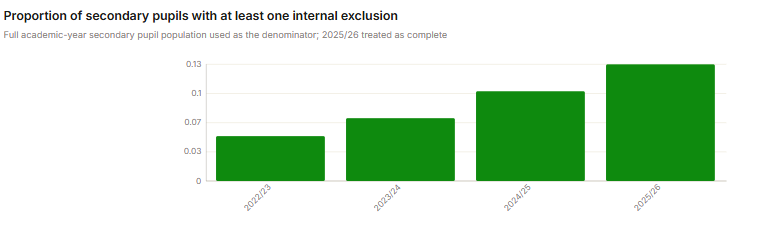
In 2022/23, 5 per cent of secondary students were removed from their normal lessons at least once during the year. By 2025/26 that had risen to 13 per cent, an increase of 160 per cent in three years. This represents a shift from around one in twenty students to one in eight.
The rise has been steady: 5 per cent in 2022/23, 7 per cent in 2023/24, 10 per cent in 2024/25 and 13 per cent in 2025/26.
Across the secondary schools using Arbor, 205,195 students were internally excluded at least once in 2025/26.
The gap between disadvantaged and non-disadvantaged students is widening
The increase is concentrated among disadvantaged students. In 2022/23, 8 per cent were removed from class at least once. In 2025/26 that figure was 22 per cent, compared with 10 per cent of non-disadvantaged students.
This represents a 175 per cent increase in three years, and it means more than one in five disadvantaged secondary students spent at least part of last year out of their normal classroom.

Nearly one in five students with an EHCP were removed from lessons
In 2025/26, 18 per cent of students with an Education, Health and Care Plan were removed from their normal lessons at least once, well above the 13 per cent secondary average.
Note on methodology
- Analysis is based on data from 13,000 schools using Arbor MIS in England, covering academic years 2022/23 to 2025/26.
- The headcounts cover only schools using Arbor MIS and are not national totals. The number of schools in the sample has grown over the period, so comparisons across years in this release are made using the share of students affected rather than raw counts.
- The data looks at the count of pupils who have had at least one internal exclusion within each academic year
- An internal exclusion here refers to when a pupil is removed from normal lessons or timetabled activity for behaviour/disciplinary reasons, but remains on the school site rather than being formally suspended from school.